How to Start a Flower Journal (and Actually Keep It Going)
Most people who press flowers end up with the same thing. A drawer full of loose pressed blooms, all lovely, all jumbled together, and no idea which walk or which garden each one came from. A flower journal fixes that. It is simply a book where your pressed flowers live next to a few words about where you found them. It takes minutes, it costs almost nothing, and a year later it is the one thing you actually pick up and look through.
Why a journal beats a box of loose flowers
A loose pressed flower is pretty. A pressed flower with a date and a place written beside it is a memory. That is the whole difference. Once your flowers are in a book they stop getting bent, lost at the back of a drawer, or stuck to each other. And because everything sits in one place, you start to see your own year taking shape: the first blossom in March, the roadside poppies in June, the last of the cosmos in October. Nothing else you make from pressed flowers gives you that.

A journal turns a pile of loose blooms into something you keep.
Press as you go, not all at once
The thing that kills most flower journals is treating it like a project. You do not need a free afternoon and forty flowers. You need one or two blooms, whenever you happen to pick them. Press them the same day, and when they come out flat a few weeks later, put them straight into the book. A small press you can keep by the back door or drop in a bag makes this easy, because the pressing happens in the moment instead of turning into a job for later. If you are just starting out, our beginner's guide covers the method in full.

The one in these photos
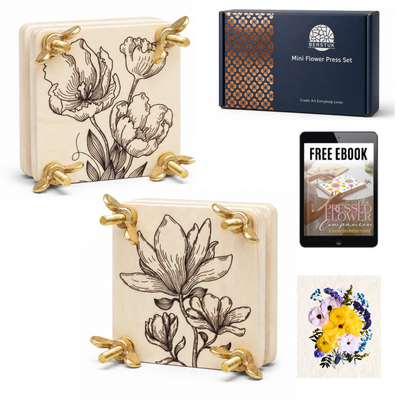
Poppy, Travel Flower Press
Small enough to keep by the back door or drop in a bag, with the paper already inside. The pressing happens in the moment, which is the whole trick to keeping a journal going.
$30.00

A few blooms at a time is all it takes.
Two dots of glue, no more: put a tiny dab of PVA or a small piece of acid-free tape at the top of the stem and one at the base. Pressed flowers are brittle, and covering the whole back in glue makes them go dark and stiff. You want the flower held in place, not drowned.
Write down more than the name
This is where a journal earns its keep. Anyone can label a flower "cornflower". What you will want in five years is everything else: the date, where you were, who you were with, what the weather was doing. "Cornflower, 14 June, the lane behind Mum's house, first properly warm day." That line takes ten seconds to write and it is what makes the page worth opening again. If you do not know what a flower is, write down what you do know and look it up later. An unnamed flower with a good note beats a named one with nothing next to it.
From the Berstuk pressing club
Get 10% off your first order, plus the pressing tips we only share with members
Paper timings, colour rescues, and the mistakes that cost people a whole batch. One email a week at most, and you can leave whenever you like.
Let it build over a season
Do not judge your journal in week one. Three pages in, it looks thin. By the end of a summer it looks like something. Keep it somewhere you will see it, use a page per outing rather than cramming, and leave a little space so you can add to a page later. If a flower comes out badly, stick it in anyway and write why. The half-brown rose you pressed a day too late is part of the record too, and it teaches you more than the perfect ones. If browning keeps catching you out, this guide to keeping the colour will help.
Nine times out of ten browning comes back to the same thing: paper that stopped absorbing and was left in place. Dry blotting paper, swapped after the first day, is what keeps a journal page bright instead of muddy.

What keeps a page bright
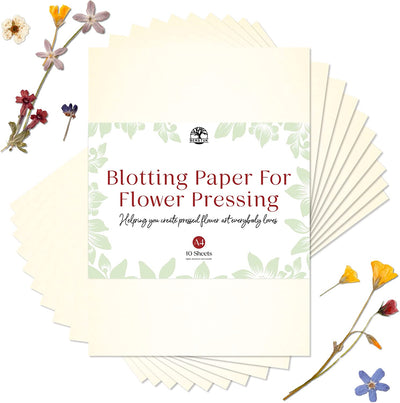
A4 Flower Press Paper
Proper unsized blotting paper, so a flower dries fast and keeps its colour. Enough sheets to keep swapping in dry ones as you press through a season.
$10.00

Small enough to take with you, so the pressing happens on the spot.
Frequently asked questions
What kind of book should I use?
Anything with thick, uncoated pages. A plain sketchbook works well. Avoid glossy paper, because glue does not hold on it and the pages stick together.
What glue is safe for pressed flowers?
A tiny dab of PVA or a small piece of acid-free tape. Two dots per flower, no more. Anything wetter will darken the petals.
Will the flowers fade in the journal?
Far less than in a frame, because the book lives closed and in the dark. That is one of the quiet advantages of a journal over a wall.
How many flowers should I do at once?
One or two. Journals die when they turn into a project. A page per outing is the sustainable pace.
What do I do with the flowers I do not use?
Turn them into cards and gift tags. Spare pressed blooms are never really spare.
Start with one flower this week. Press it, stick it down, and write a single line underneath about the day you picked it. That is a flower journal. Everything after that is just turning the page.

A season, page by page.
Questions? We're always happy to help at info@berstukstore.com